
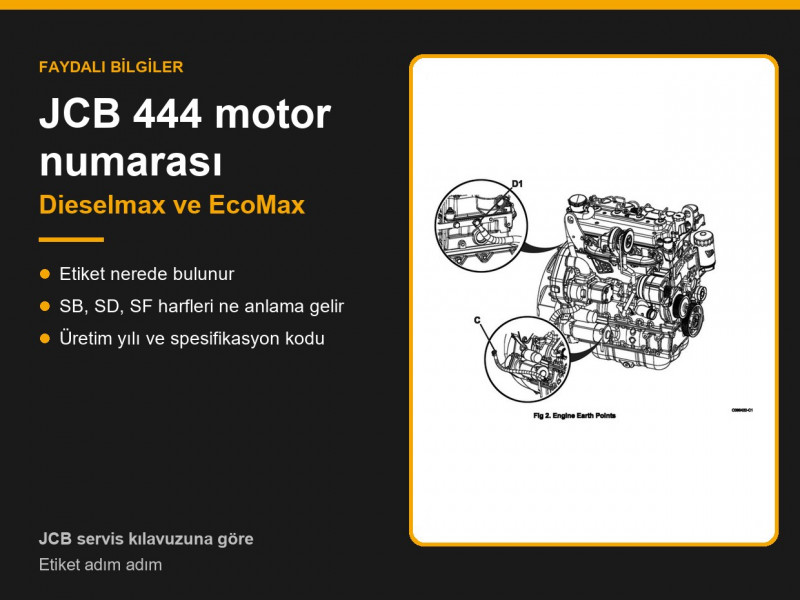
Where to find the engine number
The engine data plate is fitted to the cylinder block and, where present, to the rocker cover. It shows the full identification number. The last three parts of the number — country, serial number and year — are also stamped directly into the cylinder block. This helps when the plate is missing or painted over: the build number is then taken from the machine documents, and the serial number and year are read from the block.
How the number is made up
A typical number looks like this: S H 320/40001 U 00001 12. It consists of six parts:
| Part | Example | Meaning |
|---|---|---|
| 1 | S | Series by displacement: S — 4.4 l, D — 4.8 l |
| 2 | H | Aspiration and fuel system type (see the table below) |
| 3 | 320/40001 | Engine build number in the JCB catalogue |
| 4 | U | Country of assembly: U — United Kingdom |
| 5 | 00001 | Engine serial number |
| 6 | 12 | Last two digits of the year of manufacture |
What the second letter means
| Code | Engine type | Emission stage |
|---|---|---|
| A | Naturally aspirated (no turbocharger) | Tier 2 |
| B | Turbocharged | Tier 2 |
| C | Turbocharged and charge-air cooled (intercooled) | Tier 2 |
| D | Turbocharged, mechanical injection | Tier 3 |
| E | Electronic Common Rail injection | Tier 3 |
| F | Turbocharged and charge-air cooled, mechanical injection | Tier 3 |
| H | Turbocharged and charge-air cooled, electronic Common Rail | Tier 4i |
For Tier 4i and Tier 4 Final engines the two-letter prefix is particularly important, because it defines the power output and the version. The JCB service manual for the Loadall 527-58 telescopic handler follows the same logic: there the SD engine is a 63 kW (85 hp) turbocharged unit, while the SF delivers 74 kW (100 hp) and is turbocharged and charge-air cooled.
Decoding example
The number SB320/41995U1683021 reads as follows: S — 4.4 l engine, B — turbocharged (Tier 2 version), 320/41995 — build number, U — assembled in the United Kingdom, 16830 — serial number, 21 — built in 2021. Complete JCB Dieselmax 444 68 kW engines are available in the catalogue, for example the JCB 68 kW engine assembly 320/40344; check the build number against the engine plate before ordering.
Base specification code
Apart from the build number, every engine has a base specification code such as 9802/2910. It describes the base configuration — displacement, aspiration, fuel system and emission stage — and tells you the engine type even when a particular 320/xxxxx number cannot be found in the reference lists:
| Code | Engine |
|---|---|
| 9802/2910 | Dieselmax Tier 2, naturally aspirated |
| 9802/2940 | Dieselmax Tier 2, turbocharged |
| 9812/2300 | Dieselmax Tier 3, turbocharged, electronic injection |
| 9812/2350 | Dieselmax Tier 3, turbocharged and intercooled, mechanical injection |
| 9812/2400 | Dieselmax Tier 3, turbocharged (variant) |
| 9812/2450 | Dieselmax Tier 3, turbocharged and intercooled, mechanical, higher power |
| 9812/8000 | Dieselmax, specification depends on the build |
| 9822/0225 | Dieselmax for the Indian market |
| 9822/0470 | Dieselmax Flex |
| 9822/0475 | Dieselmax built from 2012 |
| 9822/0500 | EcoMax Tier 4i |
| 9822/0615 | EcoMax Tier 4i, alternative specification |
| 9822/0620 | Dieselmax built from late 2013 |
| 9822/0920 | EcoMax Tier 4 Final |
Why it matters when ordering parts
- Engine assembly. A replacement is selected by the build number together with the specification code: engines of the same power differ in ancillaries, component layout and injection system.
- Pistons, gaskets, cylinder head. The displacement (S or D) and the engine type given by the second letter rule out unsuitable parts straight away.
- Fuel system. Mechanical injection and Common Rail (letters E and H) use different pumps, injectors and sensors.
- Year of manufacture. The last two digits help you allow for the changes JCB made to its engines over the years.
Engine parts are grouped in the JCB Dieselmax engine section, filters and belts in genuine JCB filters and JCB belts. For engine data on backhoe loaders, see the article JCB Dieselmax engine on the 3CX and 4CX. Send us a photo of the engine plate together with the machine model and serial number, and we will decode the number and select the right parts.
Parts enquiries


