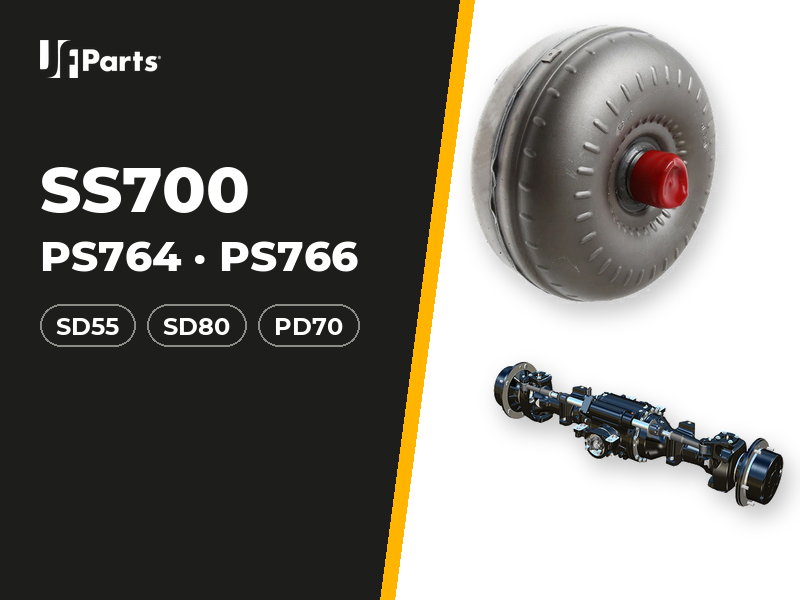
Gearbox and axle parts are matched to a specific unit. Here is which transmissions and axles are fitted to JCB 3CX and 4CX backhoe loaders and how to tell them apart. The data comes from the JCB service manual for 3C, 3CX and 4CX backhoe loaders (machines with serial numbers 960001–989999, 1327000–1349999 and 1616000–1625999).

Gearboxes

Synchro Shuttle SS700
4 forward and 4 reverse gears. Gears are selected with a mechanical lever, direction with a column switch. The parking brake is a disc on the rear axle flange.
SS700 Type 2
The same design; it differs in having no layshaft access cover.
Powershift PS764
4 forward and 4 reverse, power shifting with a single column switch. A block of 7 solenoid valves on the gearbox; a wet parking brake inside the transmission.
Powershift PS766
6 forward and 4 reverse, electronic ShiftMaster control only, a block of 8 valves.

All these gearboxes work with a 310 mm torque converter, for example 04/600784. The gearbox number is stamped on its plate; when ordering gears, also check the number stamped on the gear itself and the number of teeth.

Axles

  • Front SD55 — four-wheel-drive machines with front-wheel steer.
  • Front SD80 — all-wheel-steer machines.
  • Front non-driven axle — two-wheel-drive machines.
  • Rear PD70 — front-wheel-steer machines.
  • Rear SD80 — all-wheel-steer machines.

Every driven axle has a 5.4:1 planetary reduction in the hubs. The rear axles have wet brakes: 5 friction and 6 counter plates per half shaft.

Why the axle ratio matters

Axles were built with different crown wheel and pinion sets, giving overall ratios from 13.7:1 to 19.2:1 (for example 15.78:1 with a 38/13 set or 18.16:1 with a 37/11 set). A replacement axle must have the same ratio as the one removed, and the front and rear axles must match each other and the gearbox. Take the data from the axle plate and, for the crown wheel and pinion, the number and tooth count stamped on the gear.

What is replaced most often

  • axle pinion seals — they can be replaced without removing the axle;
  • friction and counter plates of the rear axle brakes;
  • Powershift solenoid valves — if a coil fails, the whole valve cartridge is replaced;
  • transmission oil pressure and temperature sensors (not repairable);
  • SS700 synchromesh;
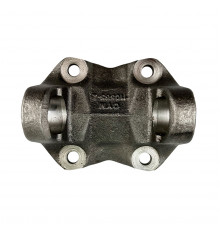
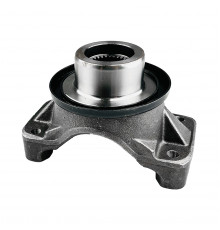
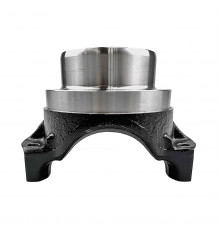
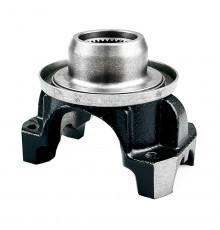
  • propshaft universal joints and straps — the straps are always renewed when removed.
Water in the gearbox oil is dangerous: as little as 0.1 % water starts the clutch linings separating. Common causes are a damaged or wrong dipstick and working in deep water.

Parts are in the Transmission and Undercarriage sections.

Help with choosing

+90 531 224 49 66WhatsAppTelegraminfo@jcbpro.net
Monday–Saturday, 9:00–18:00, closed on Sunday

02/10/2026 53
More from this section
07/10/2026 26
JCB JS200–JS260 Monitor Messages: What They Mean and What to Check
On JCB JS200, JS210, JS220, JS240 and JS260 tracked excavators with the AMS control system, the monitor in the cab shows the working mode, the time, gauges for oil temperature, coolant temperature and fuel level, and warnings in the message line. Each message first of all points to a real problem: low fuel or coolant, a blocked filter, overheating. But if a message stays on after the cause has been put right, the sensor, wiring or controller is at fault. Below is what each message means and what to check, based on Section C of JCB service manual 9803/6400.
07/10/2026 34
JCB JS200–JS260 Track Tension: How to Check the Sag and Adjust the Tracks
Track tension on the JCB JS200, JS210, JS220, JS240 and JS260 tracked excavators should be checked every shift. With the track raised off the ground, the gap between the underside of the track frame and the top of the track shoe at the fourth bottom roller from the front should be 275–295 mm on hard ground and 320–340 mm on soft sand and sticky clay. Tension is adjusted with grease through the valve on the track adjuster cylinder. The procedure below follows Section 3 of JCB service manual 9803/6400.
07/10/2026 22
JCB 3CX and 4CX Dipper Ram Creep: Causes, Ram Creep Tests and Repair
If the dipper of a JCB 3CX or 4CX backhoe loader drops on its own under load, there are three possible causes: a leaking piston seal in the ram, spool leakage in the excavator valve section, or a leaking auxiliary relief valve (ARV) in that section. The JCB service manual gives a test procedure that identifies the culprit before the ram is removed and stripped. Below are the test sequence, the permitted creep and the repair rules from Section E of service manual 9803/3290.
07/10/2026 26
JCB 3CX and 4CX Hydraulic Oil: HP32 or HP46, System Capacity and Changing the Oil
For the hydraulic system of JCB 3CX and 4CX backhoe loaders, the JCB service manual recommends ISO VG32 oil — JCB Hydraulic Fluid HP32 — at air temperatures below +38 °C. The more viscous ISO VG46, JCB High Performance Hydraulic Oil, is for air temperatures above +38 °C only. Machines with Advanced EasyControl joysticks need a separate all-season HV class oil, JCB Multigrade Anti Shear. The hydraulic system holds approximately 130 litres. The oil is changed every 2000 hours and the filter at every 500-hour service.
07/10/2026 33
JCB 3CX and 4CX Antifreeze: Which Coolant to Use, How Much and How to Change It
On JCB 3CX and 4CX backhoe loaders with the JCB Dieselmax engine, the coolant is renewed every two years, at the 2000-hour service. The cooling system holds 18.5 litres. The JCB service manual calls for an ethylene glycol antifreeze to ASTM D6210 with corrosion inhibitors and rules out organic acid technology (OAT) products. The standard mix is 50%, which gives protection down to −40 °C. Below we cover choosing, checking and changing the antifreeze as described in Section 3 of JCB service manual 9803/3290.
Parts from this article

This site uses essential cookies (session, cart, language, currency). If you click «Accept», Google Analytics and Yandex Metrica cookies are also used for visit statistics; if you click «Decline», they are not loaded. Personal data is processed under the Turkish data protection law KVKK No. 6698. Details: Privacy and cookie policy.