

Extending stabiliser legs and the extending dipper (Extradig) slide on replaceable wear pads. If they are not adjusted and replaced in time, the sections start to rub metal on metal — and the repair costs far more than the pads. The data comes from the JCB service manual for 3C, 3CX and 4CX backhoe loaders.
Stabiliser leg wear pads
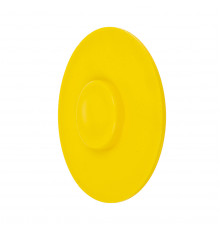
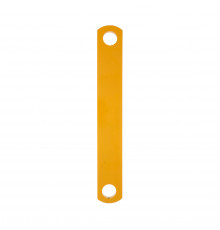
On a sideshift backhoe loader the stabiliser legs are telescopic: the inner section slides in the outer one on wear pads. At the top there are four pads in three thicknesses — 5, 6 and 7 mm, told apart by colour: green, red and blue. At the bottom there are two adjustable and two fixed pads.
- Replace the pads when worn down to 0.5 mm. The fixed bottom pads carry most of the load: check them more often and replace the whole bottom set.
- Float of the inner section must not exceed 1 mm; it is set by choosing the thickness of the top pads.
Adjustment:
1
Raise the leg off the ground, but do not retract it fully.
2
Screw the adjustable bottom pad in until it touches, then back it off a quarter of a turn.
3
Do not overtighten: the pad binds, can no longer be unscrewed, and the bottom pads wear faster.
Grease the thread of the adjustable pad, for example with JCB slew grease 4003/1601.
Extending dipper (Extradig) wear pads
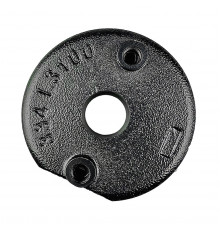
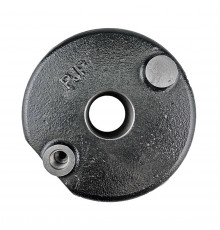
The dipper has two sets of pads, front and rear. The top pads are not adjustable: they are replaced when worn down to the chamfer. The adjustable bottom pads take up the wear of both top and bottom pads. Top and bottom pads are only replaced as a set.
1
Clean the sliding surfaces, retract the dipper and hold the bucket off the ground.
2
Check the gap between the inner section and the top pad — no more than 1.5 mm.
3
Slacken the locknuts and turn the adjusters in evenly on both sides to a 1.5 mm gap, keeping the section central; tighten the locknuts.
4
If the adjuster thread is already flush with the locknut and the gap is still over 1.5 mm, replace the pad set.
After adjustment, coat the inner section runners with Waxoyl.
The dipper top pad bolts are tightened to 49 Nm, the locknuts of the later-type adjusters to 100 Nm.
Parts in the catalogue
- Stabiliser upper wear pad 331/20552 — plastic and textolite;
- Stabiliser lower wear pad 123/06014;
- Stabiliser adjusting nut guide 331/22380;
- boom and dipper parts are in the Backhoe arm section.
Help with choosing
05/10/2026
30
More from this section

05/10/2026
35
Heavy steering on a JCB 3CX/4CX: causes and checks
If the steering of a backhoe loader has become heavy, do not rush to replace the steering unit: the cause is often simpler. Here is the order to check things in, from tyres to track rods. The data comes from the JCB service manual for 3C, 3CX and 4CX backhoe loaders.

05/10/2026
33
JCB 3CX/4CX parking brake: adjustment and wear
The parking brake on JCB 3CX and 4CX backhoe loaders comes in two types, depending on the gearbox. Here is how to test it, adjust it and when to replace parts. The data comes from the JCB service manual for 3C, 3CX and 4CX backhoe loaders.
02/10/2026
56
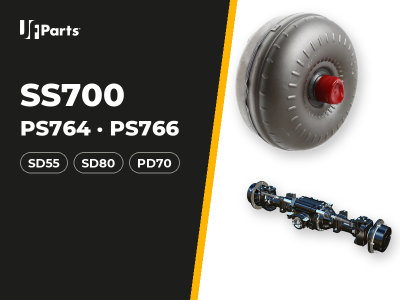
Which gearbox and axles are fitted to your JCB 3CX/4CX
Gearbox and axle parts are matched to a specific unit. Here is which transmissions and axles are fitted to JCB 3CX and 4CX backhoe loaders and how to tell them apart. The data comes from the JCB service manual for 3C, 3CX and 4CX backhoe loaders (machines with serial numbers 960001–989999, 1327000–1349999 and 1616000–1625999).
02/10/2026
47
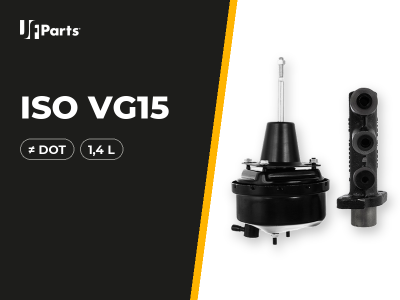
Brake fluid for JCB 3CX/4CX: why not DOT and how to bleed the brakes
On JCB 3CX and 4CX backhoe loaders the brakes do not run on ordinary brake fluid. Here is what to fill, how to bleed the system and which symptoms point to which fault.

02/10/2026
61
How to find a JCB part number and the machine VIN
The quickest way to find a part is by its part number — the number in the manufacturer's catalogue. If there is no number, the machine number (VIN) and the engine number help. Here is where to find them and what to send us.
Parts from this article
910/60106

331/43844

333/P7728, 128/10774
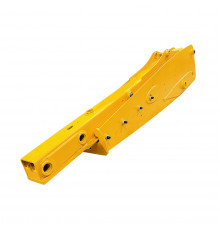
125/35200

125/79800

128/E5496

333/E5750

333/E5750
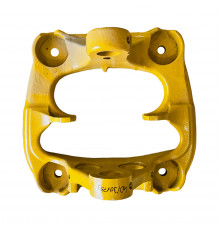
126/00526

331/43843

160/00993

816/13318

331/43840

123/06014
123/03215

331/43840
123/06751
128/14726
123/08030

401/G2857
